Why Most Product Features Fail Before They're Built
Most product features don't fail after launch—they fail long before a single line of code is written. Learn why great product teams prioritize problem validation over feature development and how better discovery leads to better products.
Contents
Why Most Product Features Fail Before They're Built
Category: Product
Author: Shivam, Founder at Fidusia
Introduction
One of the biggest misconceptions in product management is believing that features fail after launch.
In reality, most product features fail long before a single line of code is written.
Not because engineering built them poorly.
Not because design wasn't polished.
Not because marketing failed.
They fail because teams start solving the wrong problem.
Over the years, while building products, working with cross-functional teams, and observing startups, I've noticed a recurring pattern:
Teams spend significantly more time discussing solutions than validating problems.
That single mistake often leads to months of engineering effort, wasted resources, and products that nobody truly needs.
This article explores why that happens—and how product teams can avoid it.
Building Features Feels Like Progress
Imagine two product teams.
Team A
- Conducts user interviews
- Analyzes product analytics
- Challenges assumptions
- Defines success metrics
After two weeks of discovery, they decide not to build the feature.
Team B
Immediately begins development.
- Three engineers
- One designer
- Two sprints
- Six weeks of work
The feature launches.
Adoption?
1.8%.
Which team created more value?
Many organizations celebrate Team B because they shipped something.
The better product decision, however, was made by Team A.
Sometimes, the most valuable feature is the one you never build.
The Cost of False Positives
Many teams mistake signals for evidence.
Examples include:
"Users asked for Dark Mode."
Did they?
Or did three vocal users request it?
"Our competitor has this feature."
Does that automatically mean your users need it?
"Leadership believes this will increase engagement."
Based on what evidence?
Ideas are abundant.
Validated evidence is not.
Every Feature Begins With an Assumption
Every roadmap item starts with an assumption.
For example:
"If we build Feature X, engagement will increase."
That's an assumption—not a fact.
A stronger hypothesis would be:
We believe introducing Feature X will improve onboarding completion from 42% to 55%, leading to increased weekly active users.
Notice the difference.
The second statement is measurable.
Good product managers validate assumptions.
Great product managers actively try to disprove them.
Four Questions Every Feature Should Answer
Before any roadmap discussion begins, every feature should answer four fundamental questions.
1. What problem are we solving?
Not:
What are we building?
A feature without a clearly defined problem is simply engineering activity.
2. How do we know this problem exists?
Evidence can come from:
- Product analytics
- Customer interviews
- Support tickets
- Session recordings
- Funnel analysis
- User research
Opinions should never replace evidence.
3. What happens if we don't build it?
This question eliminates many low-impact ideas.
If delaying the feature has little consequence, perhaps it isn't solving a meaningful problem.
4. How will success be measured?
Every feature should define measurable success before development begins.
Examples include:
- Increase activation by 12%
- Reduce churn by 8%
- Improve conversion rate
- Increase weekly active users
- Reduce onboarding drop-offs
Without predefined metrics, every shipped feature appears successful.
The Feature Factory Trap
Many startups unintentionally become feature factories.
A customer requests something.
Build it.
Sales requests another feature.
Build it.
Leadership has an idea.
Build it.
Eventually, the product becomes larger.
Not necessarily better.
Feature count is not a measure of product quality.
Often, the highest-leverage decision is simplifying the product rather than expanding it.
Shipping Isn't the Goal
Many organizations measure success by output.
Imagine two product managers.
Product Manager A
Ships fifteen features.
Business metrics remain unchanged.
Product Manager B
Ships two carefully validated features.
- Retention increases by 18%
- Activation improves by 12%
Who created more impact?
The answer is obvious.
Yet many organizations continue rewarding output instead of outcomes.
A Better Way to Think
Whenever I evaluate a feature idea, I mentally follow this sequence:
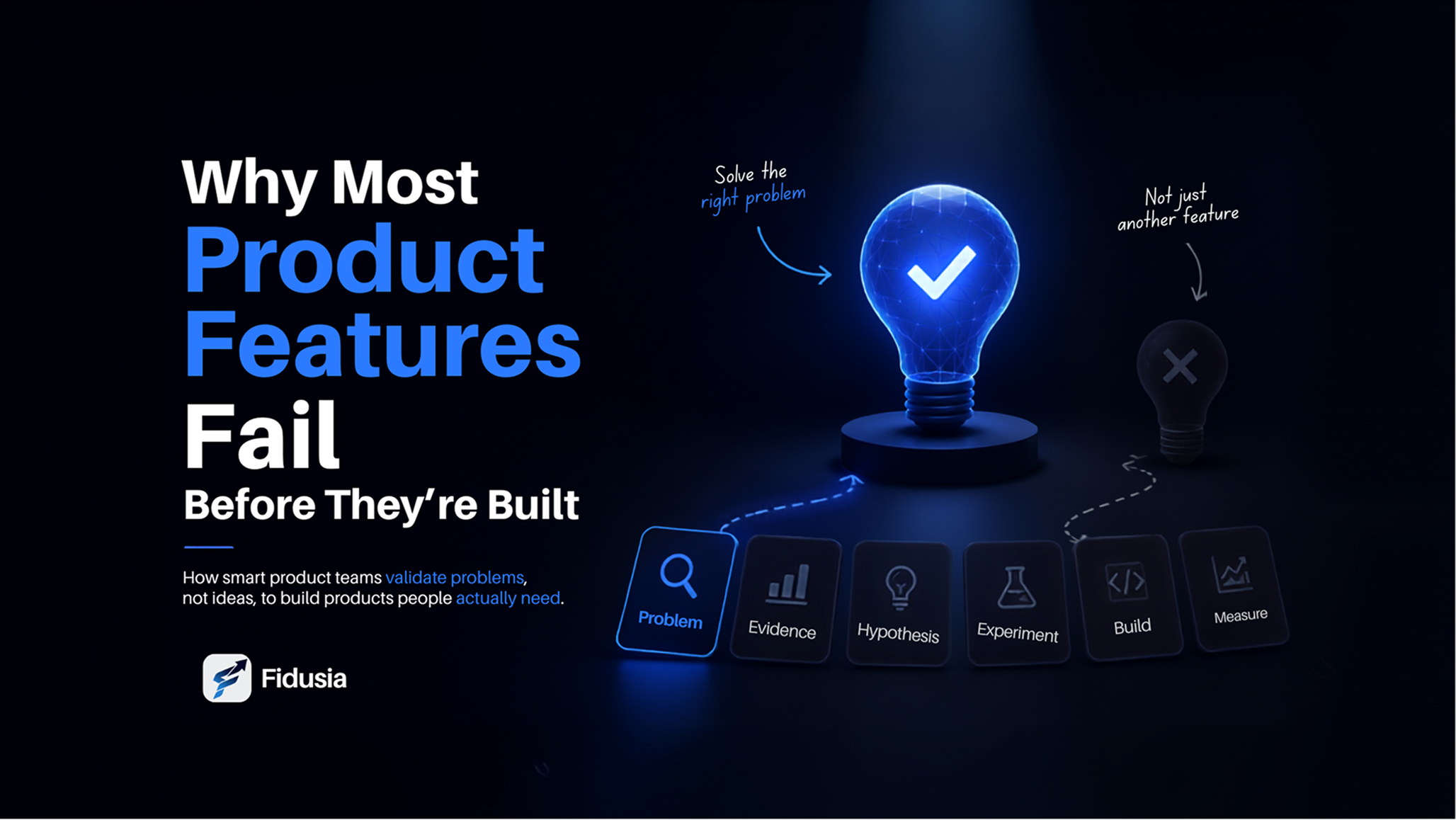
Problem → Evidence → Hypothesis → Experiment → Build → Measure
Notice what comes first.
The problem.
Not the solution.
Solutions should earn their place through validation—not assumptions.
That subtle mindset shift changes how products evolve.
Questions Worth Asking Before Every Sprint
Instead of asking:
What should we build next?
Ask:
- Which customer problem is costing us the most today?
- What evidence supports this problem?
- What's the smallest experiment we can run?
- What outcome are we trying to improve?
- What would convince us not to build this?
Great product teams aren't afraid of killing ideas.
They're afraid of building the wrong ones.
Key Takeaways
- Most features fail during discovery—not development.
- Assumptions should be validated before writing code.
- Evidence should drive product decisions.
- Every feature needs measurable success metrics.
- Great product managers optimize for outcomes—not output.
Final Thoughts
Product management doesn't begin with a roadmap.
It begins with curiosity.
The best product managers spend more time understanding users than brainstorming solutions.
Because once you've deeply understood the problem, the right solution often becomes obvious.
And sometimes, the best product decision isn't shipping another feature.
It's deciding not to build one at all.
About the Author
Shivam is the Founder of Fidusia, where he writes about product management, product strategy, UX, growth, and the decision-making behind building products people love.