Why Experienced Pentesters Spend More Time Reading Applications Than Attacking Them
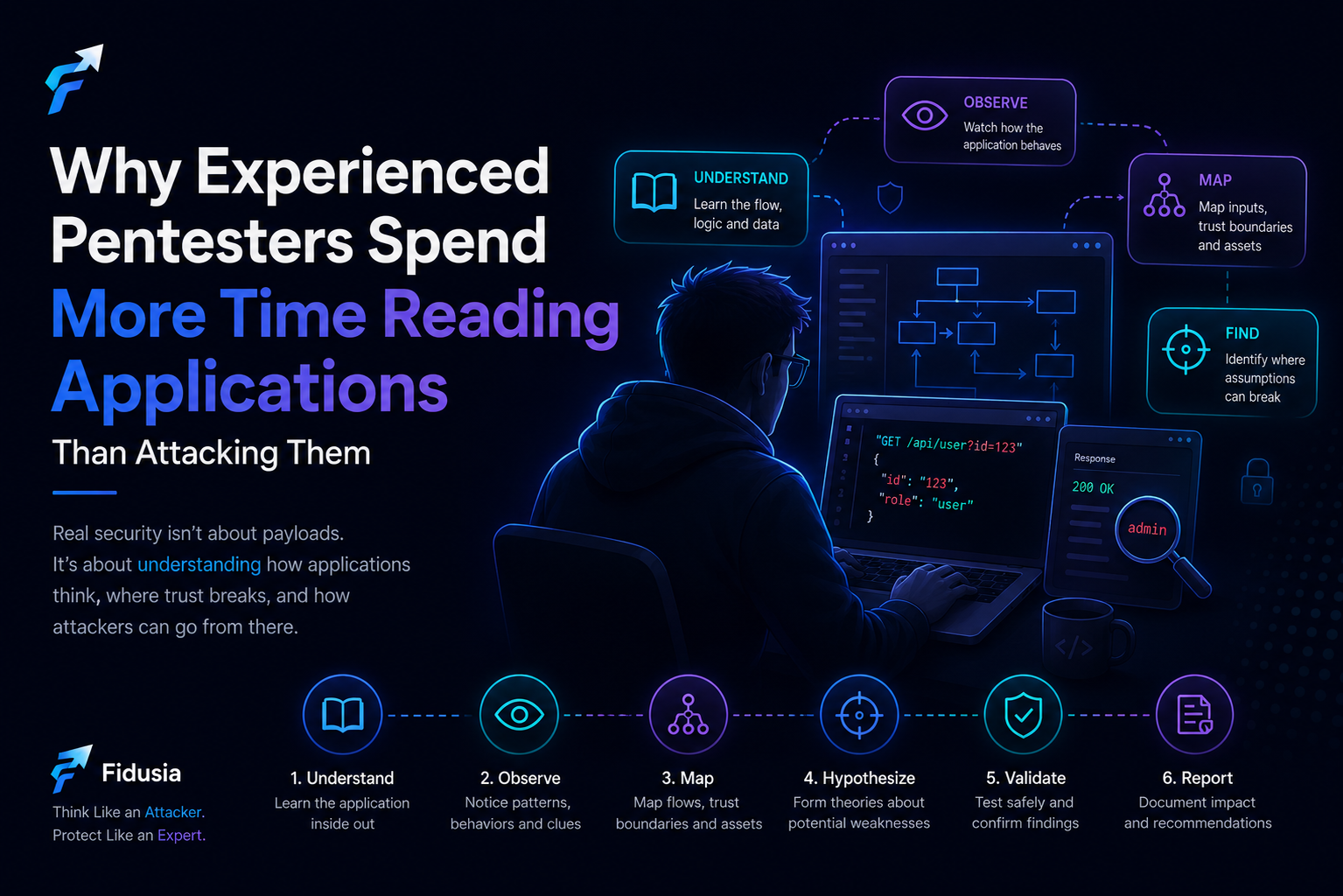
Most people think penetration testing is about payloads and exploitation. In reality, experienced security researchers spend most of their time understanding applications, mapping trust boundaries, and observing behavior before attempting any validation.
Contents
Why Experienced Pentesters Spend More Time Reading Applications Than Attacking Them
Category: Cyber Security
Difficulty: Advanced
Author: Fidusia Security Team
Introduction
If you've ever watched cybersecurity videos on YouTube, it probably looks like penetration testing is all about exploits.
Someone launches Burp Suite.
Runs an automated scan.
Finds a vulnerability.
Reports it.
The reality is much less glamorous—and much more interesting.
Most experienced penetration testers spend surprisingly little time attacking applications.
Instead, they spend the majority of their assessment simply understanding how an application works.
That difference separates someone who knows security tools from someone who understands security.
The Biggest Misconception About Penetration Testing
New researchers often imagine assessments like this:
textPayload

↓

Exploit

↓

Report
Professional engagements usually look more like this:
textUnderstand

↓

Observe

↓

Map

↓

Hypothesize

↓

Validate

↓

Document
Notice something?
Actual exploitation appears near the end.
Not the beginning.
Applications Constantly Leave Clues
Every application tells a story.
Not through documentation.
Through behavior.
Experienced security researchers continuously observe things like:
- Response timing
- Error handling
- Redirect behavior
- Session management
- Cookies
- Headers
- API responses
- Access control patterns
Each observation reduces uncertainty.
Security isn't guessing.
It's collecting enough evidence until the system begins explaining itself.
Thinking Like an Attacker Starts With Curiosity
Before attempting to identify vulnerabilities, experienced pentesters usually ask questions like:
- Where does user input enter the application?
- Which services process that input?
- Which systems trust it?
- Which actions require authentication?
- What assumptions does the application make?
Every answer improves the mental model.
The stronger the mental model, the easier it becomes to identify unexpected behavior.
Great Pentesters Build Mental Models
Beginners often memorize payloads.
Experienced researchers build mental models.
Instead of asking:
Which payload should I use?
They ask:
How does information move through this application?
Then:
Which components trust that information?
Finally:
Where could that trust break down?
Those questions apply regardless of programming language, framework, or cloud platform.
Payloads change.
Thinking scales.
Automation Isn't Intelligence
Modern security tools are incredibly powerful.
Automated scanners can identify:
- Known CVEs
- Missing security headers
- Misconfigurations
- Weak TLS settings
- Common injection patterns
What they struggle with is understanding business logic.
For example:
- Can one customer access another customer's invoice?
- Can workflow steps be skipped?
- Can permissions be inherited incorrectly?
- Can approval processes be bypassed?
These problems rarely appear in automated scan results.
They require human reasoning.
Every Assessment Begins With Four Questions
Whenever I approach a new application, I mentally answer four simple questions.
1. What accepts user input?
Forms.
Headers.
Cookies.
APIs.
Everything begins with input.
2. What processes that input?
Applications rarely process data directly.
Input often flows through:
- APIs
- Microservices
- Queues
- Authentication providers
- Databases
Understanding that journey reveals potential attack surfaces.
3. Which components trust the data?
Every trust relationship introduces risk.
Security researchers look for situations where applications trust data without sufficient validation.
These trust boundaries are often where meaningful vulnerabilities emerge.
4. What happens when assumptions fail?
Most vulnerabilities don't happen because developers write bad code.
They happen because systems assume something will always be true.
For example:
- Users won't modify requests.
- IDs can't be guessed.
- Clients behave honestly.
- Internal services are trustworthy.
Security testing is largely about validating those assumptions.
Observation Beats Memorization
Many beginners spend months memorizing payloads.
Experienced professionals spend years improving observation.
They notice:
- Small inconsistencies
- Unexpected workflows
- Timing differences
- Permission mismatches
- Error handling patterns
Those observations often lead to discoveries that automated tools completely miss.
Why This Matters
The cybersecurity industry changes rapidly.
New frameworks appear.
Programming languages evolve.
Cloud platforms introduce new services.
Attack techniques improve.
One skill remains valuable across every technology stack:
The ability to understand how software behaves.
That's what experienced penetration testers practice every day.
Key Takeaways
- Great pentesters spend more time observing than exploiting.
- Understanding application behavior is more valuable than memorizing payloads.
- Security assessments begin with curiosity, not scanners.
- Trust boundaries often reveal more than source code.
- Strong mental models consistently outperform large tool collections.
Final Thoughts
People often ask:
"Which security tool should I learn first?"
A better question is:
"How can I become better at understanding software?"
Because tools change every year.
Thinking doesn't.
The best penetration testers aren't simply better hackers.
They're better observers.
And observation is a skill that compounds over an entire career.
About the Author
Fidusia Security Team publishes practical, research-driven content focused on offensive security, defensive engineering, cloud security, and secure software development. Our mission is to help security professionals develop the mindset required to understand modern systems—not just the tools used to test them.