Product Breakdown: 4 LinkedIn Features That Could Improve Hiring and Networking
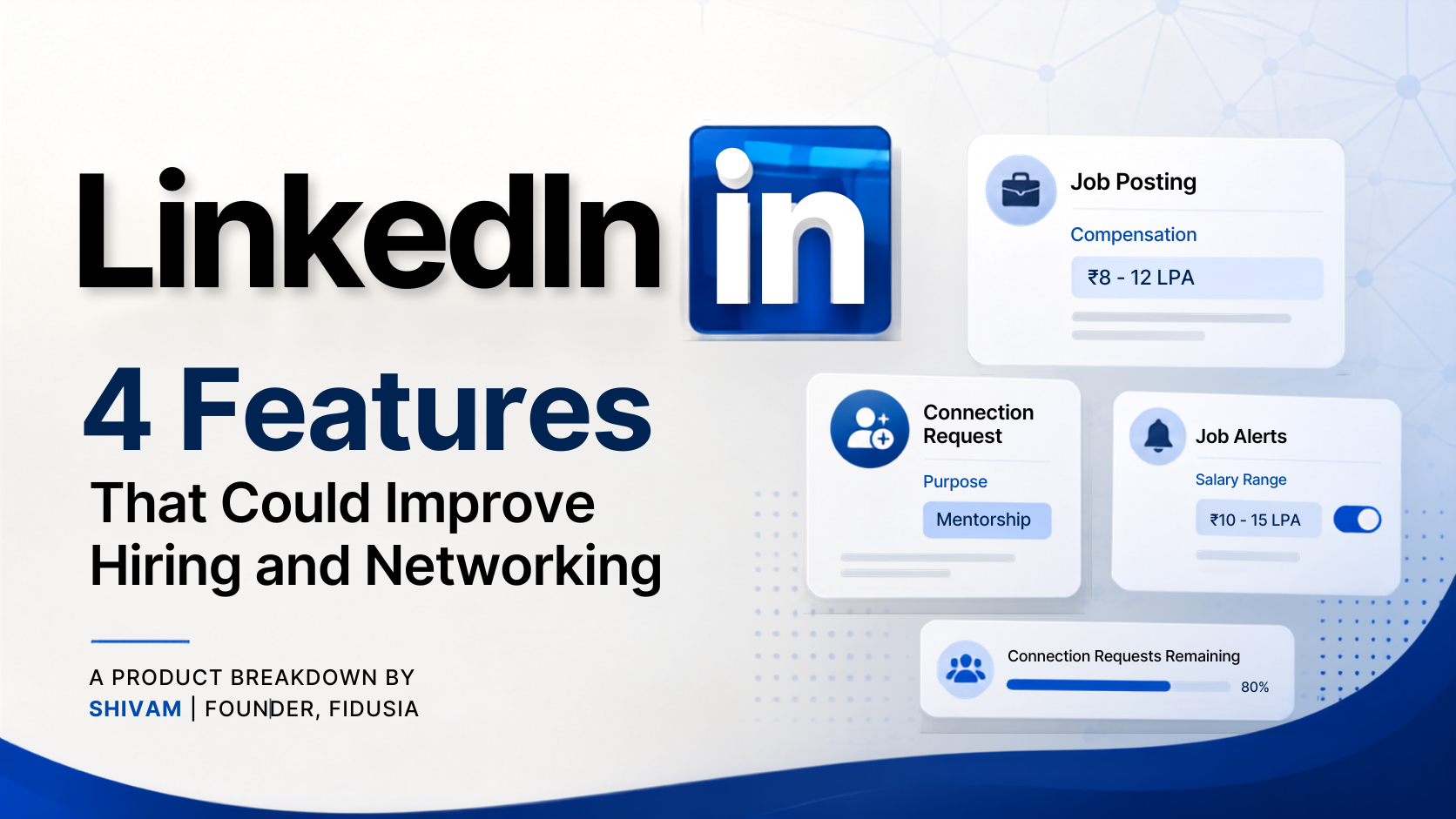
LinkedIn powers millions of professional connections every day, yet small UX gaps continue to create unnecessary friction for job seekers and recruiters. In this product breakdown, we explore four practical feature improvements that could make hiring, networking, and job discovery more transparent and efficient.
Contents
Product Breakdown: 4 LinkedIn Features That Could Improve Hiring and Networking
Category: Product
Author: Shivam, Founder at Fidusia
Introduction
LinkedIn has become the world's largest professional network, connecting millions of professionals, recruiters, founders, and students every day.
Whether you're searching for your first internship, hiring talent, or building meaningful professional relationships, LinkedIn has become an essential part of the journey.
However, even mature products have room for improvement.
While actively using LinkedIn for networking, hiring, and job discovery, I noticed several recurring usability issues. Individually they may seem small, but together they create unnecessary friction across the user journey.
This article explores four product improvements that could make LinkedIn more transparent, efficient, and user-centric.
1. Compensation Shouldn't Be Hidden Inside Job Descriptions
The Problem
Finding salary information often feels like a treasure hunt.
Some recruiters mention it in the final paragraph.
Others hide it between responsibilities.
Many don't mention it at all.
Candidates spend valuable time evaluating opportunities that may never match their expectations.
Proposed Solution
Introduce a standardized job posting template with structured fields for:
- Compensation (CTC/Stipend)
- Employment Type
- Work Mode
- Experience
- Responsibilities
- Required Skills
- Benefits
Instead of embedding salary information inside free-form text, LinkedIn should treat compensation as structured metadata.
Benefits
For Candidates
- Better transparency
- Faster decision making
- Easy comparison between opportunities
- Reduced application fatigue
For Recruiters
- Better qualified applicants
- Reduced interview mismatches
- Improved hiring efficiency
For LinkedIn
- Rich structured data
- Better recommendation engine
- Improved search filters
- Higher user trust
Tradeoff
Some employers may prefer not to disclose compensation.
A simple "Not Disclosed" option preserves flexibility while increasing transparency compared to today's experience.
2. Connection Requests Need More Context
The Problem
Most connection requests look exactly the same.
Recipients rarely know why someone wants to connect.
Is it:
- Networking?
- Referral?
- Mentorship?
- Hiring?
- Business?
Without context, many requests are ignored.
Proposed Solution
Allow users to optionally categorize connection requests.
Example categories:
- Job Search
- Mentorship
- Networking
- Business Opportunity
- Hiring
- Collaboration
Recipients immediately understand the sender's intent before accepting the request.
Reminder System
If a request remains unopened:
- Send a reminder after 7 days.
- Allow one optional follow-up after 14 days.
Reminder frequency should be limited to prevent spam.
Benefits
- Higher acceptance rates
- Better networking quality
- Improved organization
- Increased platform engagement
Tradeoff
Priority categories can be abused.
LinkedIn can solve this by limiting reminder frequency and restricting repeated "high priority" requests.
3. Compensation-Based Job Alerts
The Problem
Job alerts today are primarily based on:
- Job Title
- Company
- Location
Compensation is one of the most important decision-making factors but isn't treated as a primary filter.
Proposed Solution
Allow users to create job alerts based on salary expectations.
Examples:
- ₹6–10 LPA
- Above ₹15 LPA
- Remote internships above ₹30,000/month
This significantly improves notification relevance while reducing alert fatigue.
4. Make Connection Limits Visible
Many students and early professionals don't realize LinkedIn has connection request limits until they suddenly hit them.
A simple progress indicator on the My Network page could solve this.
Example
Connection Requests Remaining

████████░░ 80%
Small UX improvements like this often have an outsized impact on user experience.
Prioritizing the Ideas
Every feature competes for engineering resources.
Using the RICE Framework (Reach, Impact, Confidence, Effort) helps prioritize objectively.
| Feature | Priority |
|---|---|
| Reminder & Follow-up System | ⭐ Highest |
| Standardized Job Template | ⭐ High |
| Connection Categorization | ⭐ High |
| Compensation-Based Job Alerts | Medium |
The reminder system stands out because it delivers significant user value with relatively low implementation effort.
Key Product Takeaways
- Transparency reduces user friction.
- Context improves networking quality.
- Structured data creates better personalization.
- Small UX improvements often create disproportionate impact.
- Product decisions should prioritize solving real user problems rather than simply adding more features.
Final Thoughts
LinkedIn has transformed how professionals build careers and relationships.
As the platform continues to evolve, refining its core experiences can create far greater value than continuously adding new capabilities.
The ideas discussed here aren't about making LinkedIn more complex—they're about making it more intuitive, transparent, and efficient for everyone involved.
Sometimes, the best product innovations aren't the biggest ones.
They're the ones that quietly remove friction from everyday experiences.