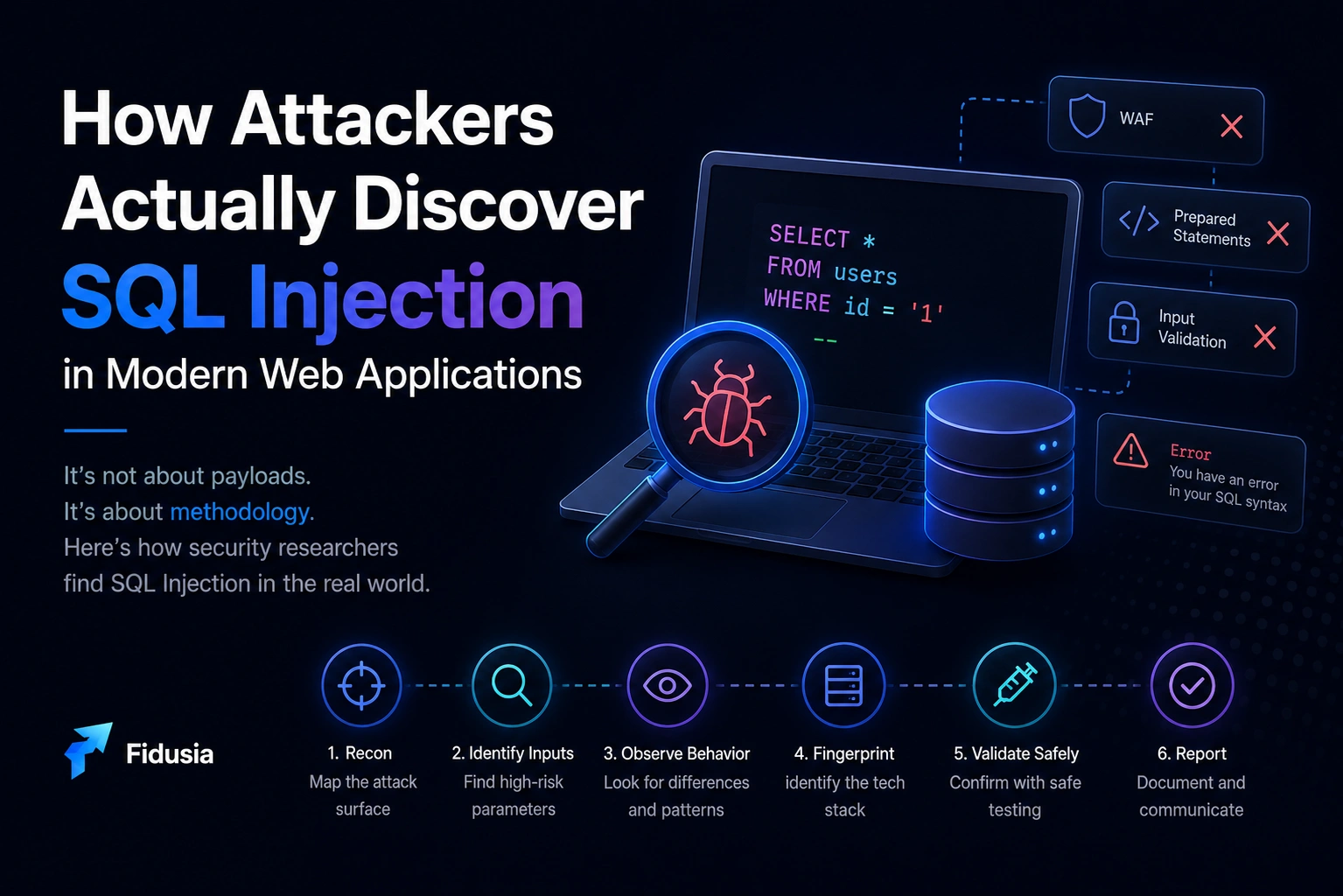
How Attackers Actually Discover SQL Injection in Modern Web Applications
SQL Injection isn't discovered by throwing random payloads at every input. Learn the methodology experienced penetration testers use to identify database attack surfaces, validate findings, and assess modern web applications safely and effectively.
Contents
How Attackers Actually Discover SQL Injection in Modern Web Applications
Category: Cyber Security
Difficulty: Advanced
Author: Fidusia Security Team
Introduction
When most people first learn SQL Injection, they focus on payloads.
sql' OR 1=1 --or
sqlUNION SELECT ...While these examples help explain the concept, they don't reflect how experienced penetration testers or bug bounty hunters approach real-world assessments.
Modern applications are protected by:
- Web Application Firewalls (WAFs)
- Prepared Statements
- ORM Frameworks
- Input Validation
- API Gateways
- Rate Limiting
Randomly testing payloads against every parameter is rarely effective.
Professional security researchers spend most of their time understanding how the application works before attempting any validation.
This article explores that methodology.
Phase 1 — Mapping the Attack Surface
Every engagement begins with reconnaissance.
The objective isn't exploitation.
It's understanding how data moves throughout the application.
Questions include:
- Which endpoints communicate with databases?
- Which parameters accept user input?
- Which APIs expose filtering or searching?
- Are legacy endpoints still active?
- Does the application expose GraphQL or REST APIs?
Useful areas include:
- Search functionality
- Login forms
- Report generation
- Export features
- Filters
- Sorting
- Admin panels
Every database query begins somewhere.
The goal is identifying that entry point.
Phase 2 — Prioritizing High-Risk Inputs
Not every parameter deserves equal attention.
Researchers typically prioritize parameters that influence backend queries.
Examples include:
text?id=
?search=
?filter=
?category=
?page=
?sort=
Modern applications frequently accept JSON requests.
Example:
json{
  "username": "shivam",
  "role": "admin"
}
Nested objects, arrays, and API payloads often receive less security testing than traditional URL parameters.
Phase 3 — Understanding Application Behavior
Before testing for SQL Injection, researchers study normal application behavior.
Questions include:
- Does the response change?
- Does execution become slower?
- Does pagination behave differently?
- Are generic error pages returned?
- Does sorting change unexpectedly?
Modern applications often suppress database exceptions.
Behavior becomes the primary indicator.
Phase 4 — Fingerprinting the Technology Stack
Understanding the technology stack helps narrow the testing strategy.
Researchers look for clues such as:
- Database technology
- Framework fingerprints
- HTTP headers
- Cookie structure
- Error page patterns
- API naming conventions
Knowing whether an application uses PostgreSQL, MySQL, SQL Server, Oracle, or SQLite influences how researchers validate observations.
Phase 5 — Identifying Injection Points
SQL Injection opportunities extend far beyond URL parameters.
Potential entry points include:
- JSON bodies
- GraphQL variables
- HTTP headers
- Cookies
- XML requests
- Multipart form uploads
- Search functionality
- Report builders
- Filtering mechanisms
Modern applications expose far more input vectors than traditional websites.
Phase 6 — Behavioral Validation
Rather than immediately attempting exploitation, experienced researchers introduce small, controlled variations in application input and observe behavior.
Possible indicators include:
- Changes in response time
- Different HTTP status codes
- Unexpected result counts
- Pagination inconsistencies
- Error handling differences
The objective is understanding application behavior—not causing disruption.
Phase 7 — Confirming the Finding
Once multiple indicators align, researchers confirm the vulnerability using safe validation techniques.
Professional assessments focus on:
- Minimizing impact
- Preserving system availability
- Demonstrating sufficient evidence
- Avoiding unnecessary data access
Responsible testing prioritizes confidence over disruption.
Common Mistakes Beginners Make
Many newcomers:
- Test every parameter equally
- Depend entirely on automated scanners
- Ignore JSON APIs
- Stop when SQL errors aren't visible
- Skip reconnaissance
- Memorize payloads instead of understanding applications
Most real-world discoveries come from observation—not luck.
Defensive Perspective
From a defensive standpoint, preventing SQL Injection requires multiple layers of protection.
Best practices include:
- Parameterized queries
- ORM frameworks with secure defaults
- Least-privilege database accounts
- Secure error handling
- Input allowlisting where appropriate
- Secure code reviews
- Continuous security testing
- Database activity monitoring
No single control eliminates risk.
Defense in depth remains essential.
Lessons From Modern Applications
Today's applications are very different from the environments used in classic SQL Injection demonstrations.
Many now rely on:
- Microservices
- GraphQL
- Serverless Functions
- Cloud Databases
- API Gateways
- Service Meshes
- Containerized Infrastructure
Understanding architecture has become just as important as understanding databases.
Key Takeaways
- SQL Injection discovery begins with understanding the application—not memorizing payloads.
- Reconnaissance is often the most valuable phase of an assessment.
- Modern applications expose many attack surfaces beyond traditional URL parameters.
- Behavioral analysis frequently reveals more than visible database errors.
- Strong defensive practices combine secure development with continuous monitoring.
Final Thoughts
SQL Injection is often presented as a payload problem.
In reality, it's an observation problem.
Experienced security professionals don't begin by asking:
"Which payload should I try?"
They begin by asking:
"How does this application actually work?"
That shift in mindset separates someone running tools from someone performing a thoughtful security assessment.
The methodology remains the same even as technologies evolve.
Understand the application first.
Everything else follows.
About the Author
Fidusia Security Team publishes practical, research-driven content focused on offensive security, defensive engineering, cloud security, and secure software development. Our goal is to help security professionals understand modern attack methodologies while promoting responsible security practices.